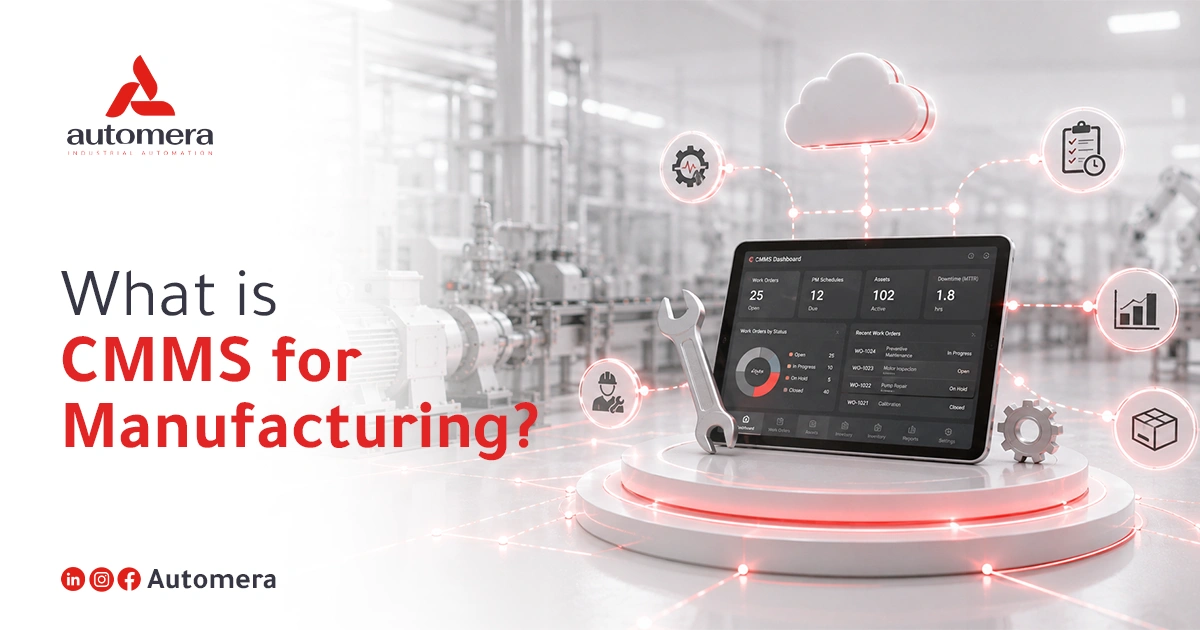
CMMS software has become an essential tool for factories and industrial facilities seeking to reduce equipment failures and improve maintenance efficiency instead of responding to problems only after they occur. The system helps organize maintenance activities, track assets, schedule tasks, and provide accurate data that supports decision-making and operational continuity. With Automera, we take a closer look at Computerized Maintenance Management Systems (CMMS) and their role in improving maintenance operations within factories.
What Is cmms system ?
CMMS stands for Computerized Maintenance Management System. It is a digital system used to organize and manage maintenance activities within factories and industrial facilities. It brings asset and equipment data, work orders, preventive maintenance plans, failure records, spare-parts information, and performance reports together in one place, making maintenance operations easier and more accurate to manage.
How Does CMMS Software Work?
CMMS software operates through a series of connected stages that help organize maintenance activities, improve operational efficiency, and reduce equipment failures:
Recording Asset and Equipment Data
The process begins by entering information about each asset or piece of equipment, including its location, technical condition, commissioning date, failure history, and previous maintenance work. The maintenance management system creates a centralized database that maintenance teams can access instead of searching through scattered files and records.
Creating Work Orders and Organizing Tasks
When a failure occurs or maintenance work is required, the CMMS allows the team to create a work order that specifies the task type, priority, assigned technician, and scheduled completion date. This makes it easier to monitor maintenance activities and track the status of every task.
Performing Maintenance and Documenting Results
After completing the task, the technician records the work performed, the time required, the spare parts used, the associated cost, and any observations concerning the condition of the asset.
Analyzing Maintenance Data and Measuring Performance
CMMS software uses recorded data to generate reports and monitor recurring failures, maintenance costs, workforce performance, and asset condition. This helps management identify problems and make decisions based on actual maintenance data.
What Are the Main Functions of CMMS Maintenance Software?
The function of CMMS software is not limited to recording maintenance activities. It provides a range of tools that help maintenance teams organize tasks and monitor equipment condition, including:
Work Order Management
The system allows teams to create maintenance work orders, set priorities, assign each task to the appropriate technician, and track its status from initial registration through completion and closure.
Asset and Equipment Management
A Computerized Maintenance Management System (CMMS) provides a centralized asset register containing essential information about each piece of equipment, including its location, specifications, failure history, and previous maintenance work.
Preventive Maintenance Scheduling
Routine maintenance tasks can be scheduled according to fixed time intervals, operating hours, or equipment usage. When maintenance becomes due, the system can automatically generate the required tasks and alerts, helping teams complete planned work on time instead of waiting for equipment to fail.
Spare Parts and Inventory Management
CMMS solutions help track spare-part quantities, storage locations, and usage in maintenance activities. They also show which parts are currently available and which need to be reordered.
Maintenance Team and Resource Tracking
Supervisors can assign tasks, monitor workloads, and track completion deadlines. Technicians can access work orders and equipment information while working in the field, especially when the system supports mobile phones and tablets.
Reports and Performance Indicators
The platform collects maintenance data and converts it into reports and dashboards that track indicators such as downtime, maintenance costs, work-order completion, Mean Time to Repair (MTTR), and equipment reliability. These insights help identify recurring problems and areas that require improvement.
What Types of Maintenance Can Be Managed Using CMMS?
CMMS software supports different maintenance strategies based on equipment condition and operational requirements. The main types include:
Corrective Maintenance
Corrective maintenance is used to resolve a fault or problem identified in an asset. The system allows the team to record the failure, create a work order, assign the responsible technician, and track the repair until completion while retaining all task details in the equipment’s maintenance history.
Preventive Maintenance
Preventive maintenance involves completing maintenance tasks before failures occur, based on a fixed schedule or equipment usage data such as operating hours.
Condition-Based Maintenance
Condition-based maintenance monitors the actual condition of equipment and triggers maintenance when specific indicators, such as temperature or vibration, reach predefined thresholds.
Predictive Maintenance
Predictive maintenance uses equipment condition and performance data, along with advanced analytics and technologies such as the Internet of Things and machine learning, to identify early warning signs of failure and determine the right time for intervention before the equipment stops operating.
What Is the Difference Between Traditional and Modern cmms programs?
Traditional CMMS solutions focus primarily on recording maintenance activities and storing data, while modern systems provide broader capabilities for monitoring, integration, analytics, and automation. The main differences include:
System Deployment and Accessibility
Traditional CMMS solutions often operate on local infrastructure within the facility. Modern systems offer cloud-based solutions that allow users to access data from multiple locations and devices without being tied to a specific workstation inside the facility.
Mobile Device Access
Modern systems allow technicians to access work orders and asset records and update task statuses using smartphones and tablets while working in the field. This reduces reliance on paper records and eliminates the need to enter information later.
Integration With Other Operational Systems
Modern CMMS software can integrate with systems such as ERP, MES, inventory management platforms, and other operational solutions. This enables data exchange between departments and reduces the need to enter the same information into multiple systems.
Connectivity With Sensors and the Internet of Things
Modern systems can receive data from sensors and IoT devices to monitor equipment conditions such as temperature, vibration, and operating hours. This information supports timely maintenance decisions.
Reporting and Analytics
Traditional systems provide basic reports based on recorded data, while modern CMMS solutions offer advanced dashboards and analytics that help track performance indicators, compare results, and identify recurring patterns in equipment failures and maintenance activities.
Predictive Maintenance and Automation Support
Modern CMMS solutions increasingly use analytics, automation, and, in some cases, artificial intelligence to detect early signs of equipment failure and automatically generate alerts or work orders based on operational data instead of relying solely on fixed maintenance schedules.
Benefits of Computerized Maintenance Management System(CMMS) in Manufacturing
Computerized Maintenance Management Systems provide manufacturers with practical benefits that improve maintenance efficiency, reduce equipment failures, and support operational continuity. Key benefits include:
- Reducing unexpected equipment failures through routine maintenance and condition monitoring before problems escalate.
- Organizing work orders by clearly defining tasks, priorities, responsibilities, and completion deadlines.
- Improving preventive maintenance efficiency by scheduling tasks and issuing timely reminders.
- Maintaining a complete asset history that includes equipment failures, repairs, and spare parts used.
- Improving spare-parts management by tracking available quantities and usage.
- Monitoring maintenance team performance through open and completed tasks and the time spent on each activity.
- Reducing emergency maintenance costs by limiting urgent repairs and unplanned downtime.
- Supporting operational decisions through reports, performance indicators, failure data, and maintenance cost information.
Three Key Signs That You Need CMMS Software
The need for CMMS software often becomes clear when existing maintenance practices can no longer keep pace with the growing number of assets, tasks, and maintenance records. The following three signs indicate that it may be time to implement a CMMS:
Frequent Equipment Failures and Reliance on Reactive Maintenance
If the maintenance team spends most of its time repairing equipment after failures occur, the facility is relying heavily on reactive maintenance. A CMMS helps organize preventive maintenance, record failure history, and monitor equipment condition, allowing teams to identify recurring problems and address them before they cause further downtime.
Maintenance Delays and a Growing Work Order Backlog
Maintenance tasks can become delayed when priorities are unclear, responsibility for execution is not properly assigned, or spare parts are unavailable. As the number of assets increases, these issues can lead to a growing work order backlog and the loss of important maintenance information.
CMMS software brings work orders, resource information, and spare-parts data together in one place. This makes it easier to see what has been completed, what remains in progress, and which tasks require immediate action or follow-up.
Limited Visibility Into Maintenance Operations
When maintenance information is distributed across multiple files or systems, managers struggle to obtain a clear view of asset condition, work orders, failure history, spare-parts consumption, and maintenance team performance. A CMMS centralizes this data and provides reports and performance indicators that make it easier to set priorities and make informed decisions.
What Should a CMMS Provide?
A computerized maintenance management software should provide practical, user-friendly tools for managing maintenance activities, accessing data, and turning that data into useful operational information. Essential capabilities include:
- Ease of use: A clear interface that simplifies task execution and access to information.
- Mobile access: The ability for technicians to view and update work orders directly from the worksite.
- System integration: Connectivity with ERP, MES, inventory management, and IoT systems to exchange data and reduce repeated data entry.
- Clear operational visibility: A complete view of assets and work orders, including task status, maintenance history, and priorities.
- Automation and alerts: Tools for scheduling maintenance and automatically generating tasks when required.
- Reports and performance indicators: Clear reporting on downtime, costs, work completion, and maintenance performance.
- Security and access control: Protection of maintenance data through defined user roles and permissions.
- Scalability and data portability: The ability to accommodate more assets, sites, and users while allowing maintenance data to be transferred when needed.
Five Key Uses of CMMS in Manufacturing
cmms computerized maintenance management system is used in manufacturing facilities to organize a wide range of maintenance activities, monitor assets and resources, and support production continuity. Five of its most practical applications include:
Managing Predictive Maintenance for Critical Equipment
Modern CMMS solutions can connect to sensor data to monitor indicators such as vibration, temperature, and equipment condition. The system can then use this data to detect changes that may precede a failure and generate an alert or work order when intervention is required.
Scheduling Preventive Maintenance for Production Lines
The system allows manufacturers to schedule routine maintenance based on time intervals, operating hours, or the requirements of each machine. This is particularly useful for facilities that need to complete maintenance work without disrupting production plans.
Managing Maintenance Across Multiple Sites
When an organization operates more than one factory or location, a computerized maintenance management system software allows it to manage work orders, maintenance plans, and asset records through a single system. Technicians can also access assigned tasks and update their status from any site.
Connecting Maintenance With Spare Parts and Inventory
A computerized maintenance management software cmms can link work orders to the spare parts used, available quantities, and reorder points. This reduces the risk of repair delays caused by the required part being unavailable.
Supporting Safety and Compliance Within the Factory
Maintenance records, inspection checklists, and documented procedures help verify that required tasks have been completed and equipment conditions are properly monitored. This is especially important in factories operating under strict safety or quality requirements.
What Is the Difference Between EAM and CMMS?
Both systems support asset management and performance improvement, but they differ in scope, functionality, and the types of data they manage. The main differences include:
Scope of Asset Management
CMMS focuses on maintaining assets that are already in operation, including work orders, preventive maintenance, equipment failures, and spare parts.
EAM covers the asset across a broader lifecycle, from acquisition and installation through operation and maintenance to decommissioning or disposal.
Functions Covered by Each System
cmms maintenance management system functions typically include work order management, maintenance scheduling, inventory tracking, equipment records, and reporting.
EAM adds broader capabilities that may include contract management, procurement, labor management, supply chain operations, costs, safety, and compliance.
Asset Cost and Lifecycle Management
computer maintenance management system software focuses primarily on asset performance and maintenance requirements during the operation and maintenance stage.
EAM provides a broader view of asset costs throughout its lifecycle, including acquisition, maintenance, repair, and service costs. This supports the assessment of the asset’s total cost of ownership.
Organizational Scope
cmms manufacturing is mainly used by maintenance and operations teams to organize daily tasks and monitor equipment. EAM serves a wider range of departments and business functions when an organization needs to manage assets, costs, and related processes through an integrated system.
Is CMMS the Same as SAP?
No, cmms software for manufacturing is not the same as SAP. CMMS is a category of software designed specifically to manage maintenance activities, while SAP is a company that provides a broad range of enterprise solutions, including software for asset and maintenance management.
CMMS primarily focuses on maintenance operations such as work orders, preventive maintenance, equipment records, and spare-parts management. SAP solutions cover a wider range of enterprise processes and can connect maintenance with procurement, inventory, production, and finance. Their role is therefore not limited to maintenance management.
What Should You Look for When Choosing a CMMS Provider?
Choosing a CMMS provider depends on its ability to implement the system successfully and support it after deployment. Key factors to evaluate include:
- Implementation experience: A proven understanding of maintenance operations and the facility’s working environment.
- Data migration and organization: The ability to accurately transfer and structure data from existing systems or files.
- User training: Proper training that enables technicians and supervisors to use the system correctly.
- System integration: The ability to connect the CMMS with existing ERP, MES, and IoT systems.
- Post-implementation support: Ongoing technical support to resolve issues and develop system usage when required.
- Clear scope and pricing: Transparent information about implementation, training, support, and integration costs.
How Much Does CMMS Software Cost, and What Factors Determine the Price?
CMMS pricing varies from one solution to another and is determined by several factors, including:
- Number of users: This directly affects the cost when pricing is based on a subscription fee per user.
- Number of assets and sites: Managing a large number of machines or deploying the system across several facilities can increase the cost.
- Required features: Pricing varies according to the selected plan, especially when advanced capabilities or additional modules are required.
- Implementation and data migration: System configuration and the import of asset, inventory, and maintenance history data may involve separate fees.
- Integration with other systems: Connecting the CMMS to ERP, SCADA, or procurement platforms may require APIs, custom connectors, or additional development.
How Does CMMS Support Preventive and Predictive Maintenance?
CMMS software transforms maintenance from a collection of disconnected tasks into an organized process based on schedules and equipment condition data. It supports preventive maintenance at the right time and helps teams act on predictive maintenance insights before failures occur by:
- Scheduling preventive maintenance according to fixed time intervals or equipment operating hours, with related tasks and alerts generated automatically.
- Monitoring equipment condition using operational and inspection data to identify assets requiring intervention before their condition deteriorates.
- Using sensor and IoT data to continuously track indicators such as vibration, temperature, pressure, and electrical current.
- Detecting early signs of failure by analyzing changes in equipment performance and comparing them with historical data and current asset condition.
- Generating alerts and work orders when equipment readings exceed predefined thresholds or indicate that maintenance intervention is required.
- Improving maintenance timing by allowing teams to intervene based on actual need instead of relying solely on fixed schedules or waiting for a failure.
- Maintaining a continuous maintenance record that helps teams review previous failures, repair outcomes, and improve future maintenance plans.
What Key Trends Are Shaping the Future of CMMS Software in Manufacturing?
The future of maintenance and operations software is moving toward greater use of artificial intelligence and the Internet of Things (IoT). Sensors can continuously collect equipment data, while analytics tools identify abnormal patterns and predict problems before they develop into actual failures.
How Does Automera Support the Next Generation of CMMS?
Automera combines experience in industrial environments with digital transformation solutions, enabling manufacturers to implement CMMS software that reflects the actual nature of their facilities and operational processes. Key advantages include:
- Solutions aligned with facility requirements: Automera studies operational processes, assets, and production requirements to develop a solution suited to each facility instead of applying the same model to every factory.
- Integration with existing systems: Maintenance solutions can be connected with ERP, production, warehouse, and other systems already operating within the facility.
- Equipment and sensor connectivity: Machines and sensors can be connected to use operational and IoT data for more accurate asset condition monitoring and maintenance management.
- Data and intelligent analytics: Maintenance and operational data can be analyzed to improve visibility and support informed decisions related to performance and maintenance.
- Intelligent preventive maintenance: CMMS solutions support maintenance planning before failures occur, helping manufacturers reduce unexpected downtime.
- Scalability as operations develop: The solution can be built around current requirements and expanded with additional capabilities as the facility grows and its operations evolve.
If you are looking to implement a system cmms that matches the needs of your facility, contact Automera to identify the right solution for your maintenance and operational requirements.