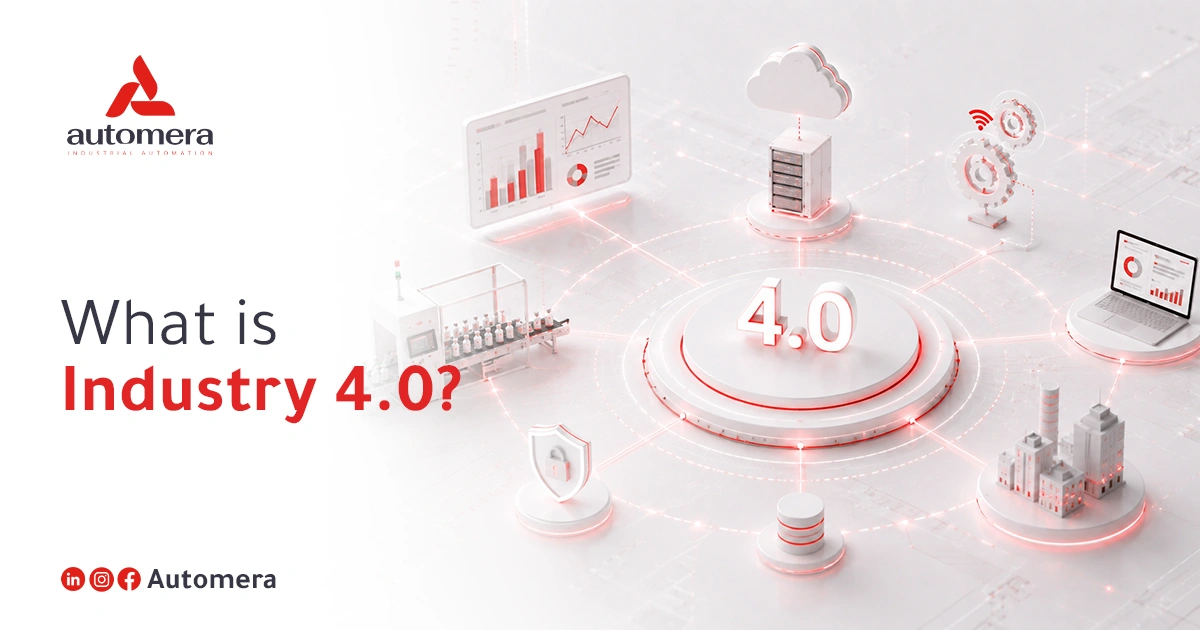
Your factory can produce more using the same equipment when it knows where time is being lost, why machines stop, and when product quality begins to decline. This ability to understand factory performance during operation is driving industrial companies to adopt Industry 4.0 technologies.
Through its Industry 4.0 consulting expertise, Automera examines the development of the Fourth Industrial Revolution, how it works, and its main applications. We also explain its benefits, challenges, and the steps required to implement it in Saudi factories.
Definition of the Fourth Industrial Revolution: Industry 4.0
Industry 4.0 is a transformation in how factories operate. It connects machines, sensors, production systems, and management systems through a unified network that exchanges data during operation. This environment uses technologies such as the Industrial Internet of Things, artificial intelligence, cloud computing, and data analytics, allowing factories to monitor their operations as they happen.
How Did the Fourth Industrial Revolution Develop?
Industry did not reach industrialization 4.0 in a single step. It was preceded by three major transformations that changed how goods were produced:
- The First Industrial Revolution: It began in the late eighteenth century with the use of water and steam power to operate machinery, reducing complete dependence on manual labor.
- The Second Industrial Revolution: It introduced electricity and assembly lines, making it faster and less expensive to produce goods in large quantities.
- The Third Industrial Revolution: Electronics, computers, and programmable logic controllers (PLCs) entered factories, allowing machines to perform many tasks automatically.
- The Fourth Industrial Revolution: Machines became connected to sensors, software, and the internet. Factories could collect and analyze operational data, monitor production, and use real-time information to support decisions as events occurred.
This level of connectivity also extends beyond the factory through Supply Chain 4.0, which links production data with inventory, suppliers, and demand.
Today, Industry 4.0 companies use this connected approach to manage production using current operational data instead of relying only on reports prepared after production ends.
What Distinguishes the Fourth Industrial Revolution from Its Predecessors?
The First Industrial Revolution relied on mechanization, the second on electricity and mass production, and the third on computers and automation. The Fourth Industrial Revolution introduced connectivity and data exchange between machines and systems, allowing factories to monitor and analyze their operations while production is running.
In the Third Industrial Revolution, a machine could perform a programmed task automatically. In the Fourth Industrial Revolution, the machine also sends data about its condition and performance and interacts with other connected equipment and systems.
What Is the industry 4.0 Manufacturing Approach?
The smart factory industry 4.0 approach collects factory data in real time and turns it into decisions that improve operations. Machines and production lines connect to systems that analyze incoming data and show teams the current production status, sources of downtime and waste, and problems that require attention.
This connection also covers maintenance, quality, inventory, and Supply Chain 4.0, allowing factory departments to work with the same accurate and up-to-date operational information.
Main Characteristics of the Fourth Industrial Revolution
smart manufacturing 4.0 has several characteristics that change how production and equipment are managed inside a factory:
- Continuous connectivity: Machines, sensors, and operating systems connect through a shared network and exchange data during production.
- System interoperability: Equipment and software can share data and work together, even when they come from different manufacturers.
- Digital visibility: Operational data provides a clear view of equipment conditions, production flow, downtime, and waste.
- Real-time response: Information about breakdowns and operational deviations becomes available as soon as they occur.
- Decentralized decisions: Some systems and machines can take automatic operational actions according to predefined data and rules.
- Production flexibility: Schedules, settings, and quantities can be adjusted quickly to meet changes in demand or manufacture products with different specifications.
- Internal and external integration: Shop-floor data connects with management, inventory, and maintenance systems, as well as suppliers and customers.
- Scalability: A factory can add new equipment, production lines, or digital functions without rebuilding its entire technical infrastructure.
How Does industrial revolution 4.0 Work?
The 4th industrial revolution operates through a connected cycle that receives factory data, analyzes it, and uses the results during production. This cycle works through the following steps:
1. Collecting Operational Data
Sensors and control units continuously record machine data, including operating speed, temperature, energy consumption, downtime, production quantities, and defect rates.
2. Transferring Data
The factory network transfers this data to operating and monitoring systems. Machines and production lines exchange information with quality, maintenance, and inventory systems.
3. Unifying Data
A central platform collects data from different sources and connects it to production orders, products, and shifts. This allows managers to check the condition of each machine and track the current stage of every production order.
4. Analyzing Performance
The systems compare actual performance with target rates. They can detect reduced machine speed, increased energy consumption, repeated stoppages, and early signs of equipment failure.
5. Responding to Problems
When the system detects a problem, it sends an alert to the responsible team showing its location and the related data. Some systems can also perform an automatic action, such as adjusting operating settings or stopping equipment when a risk is detected.
6. Updating Factory Systems
Data on production, material consumption, downtime, and quality results is transferred to MES, ERP, and maintenance systems. This keeps inventory, cost, and order information aligned with what is happening on the production lines.
7. Measuring the Result
The system records the action taken by the team and compares equipment performance before and after the intervention. This comparison shows whether the action was successful and helps reduce the recurrence of the problem.
What Is the Relationship Between Smart Manufacturing and Industry 4.0?
The concept of industrial revolution 4.0 was originally developed to improve how factories operate and manage production. It connects equipment and production lines to systems that collect operational data in real time, giving managers a clear view of machine conditions, production quantities, quality levels, and causes of downtime.
This data also connects the shop floor with planning, maintenance, inventory, and supply chain departments. If a production line slows down, a machine fails, or the defect rate increases, the problem becomes visible as it occurs and the responsible team can respond immediately. This direct connection to factory operations explains the close relationship between industry 4.0 and digital transformation and manufacturing.
Why Is Industry 4.0 Important for Factories?
Factories now operate in a market that demands greater product variety and shorter delivery times while maintaining quality and controlling production costs. Industry 4.0 gives factories greater operational flexibility because:
- Production planning, equipment conditions, quality, and inventory are connected within one digital environment.
- Factories can adjust production plans when demand changes and schedule maintenance according to equipment conditions.
- Materials and products can be traced, and customized orders can be produced without losing control over time and cost.
For these reasons, Industry 4.0 has become closely linked to a factory’s ability to remain competitive, particularly in industries where demand changes rapidly or strict quality and traceability requirements apply.
What Industry 4.0 Technologies List?
Industry 4.0 automation is driven by a group of technologies that connect industrial assets with software systems. These technologies include:
- Industrial Internet of Things (IIoT): Connects equipment, sensors, and control units to the network and transmits real-time data on machine conditions, performance, and energy consumption.
- Cyber-Physical Systems (CPS): Connect physical equipment to digital systems that monitor its behavior and enable control and interaction with changing operating conditions.
- Industry 4.0 AI and machine learning: Process industrial data to detect unusual patterns, predict failures, improve production schedules, and identify signs of declining quality.
- Big Data and Industrial Analytics: Combine data from production, equipment, materials, and shifts, then turn it into indicators that reveal bottlenecks, sources of waste, and opportunities to increase production capacity.
- Edge Computing: Processes data close to its source inside the factory, providing the rapid response required for safety, control, and quality inspection applications.
- Cloud Computing: Supports data storage, application operation, and performance comparisons across production lines and locations, with the capacity to scale according to factory needs.
- Advanced Robotics and Machine Vision: Handle tasks such as material handling, assembly, and inspection. Machine vision systems can identify defects and deviations quickly and accurately.
- digital twin in industry 4.0: Provide digital models of equipment or production lines that can be used to run simulations, test operating settings, and examine the effects of proposed changes.
- Augmented Reality: Displays maintenance instructions, assembly guidance, and equipment data in front of technicians while they work, reducing the time required for diagnosis and training.
- Additive Manufacturing: Enables prototypes and customized parts to be produced directly from digital files, supporting product development and limited-volume production.
- Vertical and Horizontal Integration: Connects the shop floor with MES and ERP systems and extends this connection to suppliers, warehouses, and other production sites.
- Industrial Cybersecurity: Protects operational networks, connected devices, and production data while maintaining operational continuity against digital threats.
What Is the Role of the Internet of Things in Industry 4.0?
Internet of things industry 4.0 acts as the connection layer between equipment and digital systems inside the factory. Sensors capture machine readings and communication gateways transfer them through industrial protocols such as OPC UA and MQTT to SCADA, MES, and data platforms.
This provides IIoT and Industry 4.0 applications with a continuous flow of actual operational data used for monitoring, analysis, and control.
What Are the Main Characteristics of Industry 4.0 Factories?
A smart factory Industry 4.0 environment is defined by how its equipment and systems communicate and respond to changes in operating conditions. Its main characteristics include:
- Operational connectivity: Machines, sensors, production systems, maintenance systems, and quality systems connect through an industrial network that allows them to exchange data.
- IT and OT integration: Shop-floor data moves from control and operating systems to MES and ERP platforms, connecting industrial operations with planning and management.
- Real-time visibility: Operational dashboards display equipment conditions, production orders, and performance rates as the data is recorded while retaining a historical record of every process.
- Digital transparency: Machine data is linked to the relevant material, production order, product, and shift.
- Autonomous response: Some systems can adjust operating settings, redistribute tasks, or stop equipment according to predefined rules.
- Production flexibility: Product specifications, batch sizes, and order sequences can be changed without rebuilding the entire production line.
- Digital simulation: Digital models and twins are used to study equipment and production-line performance and test changes before applying them to actual operations.
- Human-machine collaboration: Operators and technicians receive direct instructions, alerts, and data that help them perform tasks and respond to equipment failures.
- Scalability: The technical infrastructure allows new equipment, production lines, or sites to be added and connected to existing systems.
- cyber security in industry 4.0: Devices, networks, and access permissions are monitored and protected because connected operational equipment creates new routes for cyber threats.
How Are Industry 4.0 Technologies Changing Manufacturing?
Data has become part of operational decision-making inside the factory. Industry 4.0 technologies have reshaped production planning, manufacturing, maintenance, and quality control in the following ways:
- More responsive production planning: Schedules are updated according to available capacity, equipment conditions, inventory levels, and demand.
- Adaptable operations: Production lines can adjust some settings according to product specifications or process conditions while supporting small batches and customized products.
- Condition-based maintenance: Maintenance teams determine when intervention is needed using vibration, temperature, pressure, and historical performance data instead of relying entirely on fixed schedules.
- In-process quality control: Sensors and machine vision systems monitor product specifications during production and identify deviations at the stage where they occur.
- Digital production traceability: Each product or batch has a record linking it to materials, equipment, operating settings, and inspection results. This supports quality investigations and product recalls.
- Connected design and production: Product updates and manufacturing instructions are sent to production teams, while performance data and operational problems return to engineering teams to improve the product and process.
- A factory-connected supply chain: Material requirements and delivery schedules are updated according to actual consumption and production, keeping inventory movement aligned with the operating plan.
- More specialized operational roles: Operators and technicians increasingly work with data, systems, and alerts, while automated equipment handles repetitive or high-risk tasks.
What Are the Benefits of Industry 4.0?
The benefits of Industry 4.0 become clear in the results a factory achieves after connecting its operations and using its data effectively. These benefits include:
- Higher asset productivity: Existing production lines can produce more units by increasing operating rates and addressing bottlenecks that restrict capacity.
- Lower cost per unit: Factories can control the consumption of materials, energy, and labor hours while reducing expenses caused by breakdowns and rework.
- Higher first-pass yield: More products meet specifications on the first production run, reducing scrap, returns, and defect correction costs.
- Shorter production lead times: Less time is spent waiting for materials, preparing equipment, and transferring work orders between departments.
- More reliable delivery: Factories can estimate production capacity accurately and identify potential delays before they affect delivery dates.
- Longer equipment life: Early signs of asset deterioration can be detected, protecting components from failures caused by operation outside acceptable limits.
- More efficient energy consumption: Factories can identify the machines and processes that consume the most energy and compare this consumption with actual production volumes.
- Improved industrial safety: Hazardous operating conditions can be monitored while reducing workers’ exposure to repetitive tasks and unsafe environments.
- Greater resilience to disruptions: Production, procurement, and resource allocation can be adjusted quickly when materials are unavailable, demand changes, or a production line stops.
- Better capital investment decisions: Factories can determine whether new equipment is actually required or whether improving the efficiency of existing assets can provide the needed capacity.
What Opportunities Does Industry 4.0 Offer Saudi Factories?
Industry 4.0 opportunities in Saudi Arabia are closely connected to the Kingdom’s efforts to diversify its industrial base and prepare factories for expansion in local and international markets. The main opportunities available to Saudi factories include:
- Increasing local content: Developing domestic production capabilities and manufacturing components that were previously imported while documenting the proportion of components and processes completed locally.
- Qualifying for major project contracts: Traceability and quality systems provide documented information about products, production capacity, and delivery schedules, which are important when applying to become a supplier for major industrial and construction projects.
- Expanding into export markets: Documenting materials, manufacturing processes, and inspection results prepares factories to enter markets with strict quality, origin, and traceability requirements.
- Serving new industrial sectors: Flexible production lines can manufacture products and components for the automotive, aerospace, pharmaceutical, food, mining, and renewable energy sectors.
- Developing products for the Saudi market: Demand and usage data helps factories modify products or produce limited quantities with specifications suited to local customers.
- Connecting multiple factories and locations: Companies operating factories or warehouses in different regions can unify production, quality, and inventory data through a central platform.
- Managing industrial resources: Data on energy, water, and materials helps factories control consumption and prepare more accurate reports on resource efficiency and environmental impact.
- Launching digital industrial services: Factories can add services such as remote monitoring, condition-based maintenance, and post-sale product performance tracking.
- Developing national capabilities: Industrial transformation creates demand for specialists in industrial automation, data analytics, cybersecurity, and smart system operations.
- Supporting local industrial innovation: Industrial data provides a foundation for product development, process improvement, and cooperation with research and development centers, an approach supported by the Innovative Factories Grant Initiative.
Practical Examples of Manufacturing 4.0 Solutions
Factories use Industry 4.0 solutions to address specific operational problems. A solution can first be applied to one production line or machine and then expanded. Practical applications include:
- predictive maintenance in industry 4.0: Sensors measure motor vibration, temperature, and electrical current consumption. The system detects changes in operating patterns and alerts the maintenance team when signs of a potential failure appear.
- Machine vision quality inspection: Cameras inspect products as they move along the production line and identify defects such as incorrect dimensions, color variations, cracks, or missing parts.
- Dynamic production scheduling: The operating system rearranges production orders when a machine breaks down, raw materials are delayed, or an order’s delivery date changes.
- Production-line simulation: A digital twin is used to test an increase in line speed, a change in equipment layout, or the addition of a new station and assess the impact before implementation.
- Digital product traceability: QR codes or RFID tags connect each batch to its raw materials, equipment, operating settings, and inspection results recorded during production.
- Autonomous intralogistics: Automated guided vehicles (AGVs) or autonomous mobile robots (AMRs) transport materials between warehouses and production lines according to system instructions.
- Energy consumption management: Smart meters measure the energy consumption of each machine or production line and identify equipment that uses excessive power while operating or idle.
- Augmented reality support for technicians: Smart glasses or tablets display maintenance instructions and equipment data while technicians perform their tasks, with the option to receive remote assistance.
What Are the Challenges of Industry 4.0?
The main challenge in Industry 4.0 is introducing technology into an existing production environment without disrupting operations. Factories may face the following challenges during this transformation:
- Legacy industrial infrastructure: Many factories operate equipment from different generations and suppliers. Some machines cannot provide the data or communication protocols required by modern systems.
- Integration gaps: Connecting machines, PLCs, SCADA, MES, and ERP systems requires a clear data architecture. Weak integration produces fragmented information and inaccurate decisions.
- Unprepared data: The value of analysis depends on the accuracy of operational data and how it is defined within the system. Recording downtime or defects under inconsistent categories reduces accuracy and makes performance comparisons difficult.
- A wider cyberattack surface: Every machine or sensor connected to the network becomes another access point that must be secured.
- High transformation costs: Costs include network preparation, equipment connectivity, data storage, employee training, and ongoing technical support, not only software.
- Difficulty calculating return on investment: Industry 4.0 projects lose their business justification when they begin without a defined operational problem or measurable indicator, such as downtime, waste, or cost per unit.
- Shortage of digital industrial expertise: Implementation requires cooperation between operations, automation, information technology, and data analytics specialists. Gaps between these disciplines can delay the project and weaken its results.
- Scaling risks: Success on one machine does not guarantee success across the entire factory. Differences in processes, protocols, and data definitions become more apparent when the solution is expanded.
- Vendor lock-in: Closed systems limit a factory’s ability to add new solutions, transfer its data, or change suppliers, which can increase future development costs.
- Resistance to change: Operators may view the system as a monitoring tool or continue using old records. This can create a digital system that does not reflect what is actually happening in production.
After reviewing the advantages and disadvantages of the Fourth Industrial Revolution, the next question is whether Industry 4.0 is suitable for your factory.
Is Industry 4.0 Right for Your Factory?
Industry 4.0 is suitable for your factory when there is a clear operational problem that data and automation can address. The following indicators can help you assess whether your factory needs it:
- Equipment failures occur repeatedly without accurate records explaining their causes.
- Production data relies on paper reports or manual entry.
- Defects are not discovered until the later stages of manufacturing.
- Materials, batches, and products are difficult to trace inside the factory.
- Production, quality, maintenance, and inventory departments report different data.
- Energy or material consumption is high, but the equipment responsible cannot be identified.
- Production orders change frequently, requiring schedules to be adjusted quickly.
- Several production lines or sites are managed without a centralized view of performance.
- Expansion or export plans require stronger documentation and quality control.
If your factory experiences any of these problems, select the one with the greatest effect on production or cost and apply an Industry 4.0 solution to it first. Measure the results before expanding the solution to other areas.
How Can Organizations Begin Adopting Industry 4.0?
The path followed by Industry 4.0 companies begins with understanding their current operations and identifying the problem that needs to be addressed before purchasing sensors or software. Saudi factories can begin through the following steps:
- Review the current level of automation, connectivity, system integration, data quality, and workforce skills. A SIRI assessment can measure the factory’s maturity and identify gaps accurately.
- Select a problem with a direct operational impact, such as excessive downtime, inconsistent quality, high energy consumption, or weak production traceability.
- Measure current performance using indicators such as OEE, defect rate, cycle time, and cost per unit. These figures provide a baseline for calculating the project’s impact after implementation.
- Form a team with representatives from production, maintenance, quality, automation, and information technology, and assign clear responsibility for the project.
- Review the machines, PLCs, SCADA, MES, and ERP systems. Identify which equipment can connect directly and which requires additional sensors or industrial gateways.
- Select one production line or critical machine for the initial implementation. Set a testing period and clear performance indicators for evaluating the results.
- Review the tracks offered by the Future Factories Initiative and other Saudi industrial programs related to digitalization and technical development.
- Once the initial project proves effective, determine which production lines and sites should follow, along with the integration, cybersecurity, and budget requirements for each stage.
What Is the Future of Industry 4.0?
The future of Industry 4.0 is moving toward factories that can interpret their data and respond to changing operating conditions with greater autonomy. The next phase will include the following developments:
- A shift toward prescriptive decisions: Analytics will advance from predicting failures and deviations to recommending suitable actions and automatically adjusting some operating variables.
- Wider use of industrial artificial intelligence: Specialized models will analyze machine data, images, and production orders, while edge computing will process a larger share of data inside the factory.
- Continuously updated digital twins: Digital models will reflect the condition of equipment and production lines during operation. Factories will use them to test schedules, settings, and maintenance plans before approval.
- Reconfigurable production lines: Factories will use modular equipment and software that allow products or batch sizes to be changed without lengthy engineering modifications.
- Unified industrial data flow: Design, production, quality, maintenance, and supply chain data will connect through a continuous digital record covering the full product lifecycle.
- More accurate monitoring of resources and emissions: Data on energy, water, materials, and emissions will become part of planning, operational decisions, and industrial sustainability reporting.
- Cybersecurity integrated into operations: Network segmentation, device monitoring, identity management, and incident response will expand to protect connected OT systems.
- An evolving role for factory workers: Systems will handle repetitive tasks and complex analysis, while people focus on supervision, problem-solving, and improvement. This development prepares the way for Industry 5.0.
In Saudi Arabia, this direction is linked to the transition toward smart factories supported by the Future Factories Initiative, with increasing adoption of advanced automation, data, and artificial intelligence across the industrial sector.
Is There an Industry 5.0?
Yes. The term Industry 5.0 describes an emerging industrial approach that builds on the technologies introduced by Industry 4.0 while extending the goals of industrial transformation to include the role of people, resource sustainability, and factory resilience.
The European Commission describes Industry 5.0 as a vision for the future of industry based on three areas: human-centricity, sustainability, and resilience. Its applications include collaborative robots that work alongside operators, systems designed to support workers, circular production processes, and supply chains that can adapt to disruptions.
Industry 5.0 is still developing and being adopted gradually. It has not yet reached the same level of industrial adoption as Industry 4.0.
What Is the Difference Between Industry 4.0 and Industry 5.0?
The main differences between the Fourth and Fifth Industrial Revolutions include:
- Industrial objectives: Industry 4.0 focuses on increasing productivity and operating accuracy. Industry 5.0 expands these objectives to include worker well-being, environmental responsibility, and the ability to withstand disruptions.
- Role of technology: Industry 4.0 uses technology to automate and improve processes, while Industry 5.0 directs technology toward supporting human capabilities and working alongside people.
- Role of workers: In Industry 4.0, workers supervise automated equipment and systems. In Industry 5.0, they play a greater role in decision-making, problem-solving, and production customization.
- Interaction with robots: Industry 4.0 relies on industrial and autonomous robots. Industry 5.0 expands the use of collaborative robots designed to work safely alongside people.
- Sustainability: In Industry 4.0, sustainability involves measuring and improving the consumption of energy and materials. In Industry 5.0, it becomes a central consideration in product, process, and supply chain design.
- Industrial resilience: Industry 4.0 focuses on predicting failures and responding to operational changes. Industry 5.0 focuses on building a production system that can continue operating and adapt to disruptions in supply, energy, and markets.
How Does Automera Implement Industry 4.0 Solutions in Your Factory?
At Automera, we implement Industry 4.0 solutions in Saudi factories according to their equipment, processes, and production goals. Implementation includes the following steps:
1. Assessing the Factory Environment
We review production lines, material flow, and existing systems to identify critical equipment, bottlenecks, downtime, and sources of waste.
2. Defining the Required Operational Data
We determine the readings required for the project, such as speed, temperature, vibration, energy consumption, production quantities, downtime, and quality results.
3. Connecting Equipment
We extract data from PLCs in modern equipment and equip older machines with suitable sensors and industrial communication gateways.
4. Preparing the Communication Network
We connect equipment and systems through industrial protocols such as OPC UA, Modbus, and MQTT while considering connection stability and operating conditions inside the factory.
5. Organizing Data and Integrating Systems
We standardize definitions for equipment, downtime, and processes. We then connect shop-floor data with SCADA, MES, ERP, maintenance, quality, and inventory systems.
6. Configuring Dashboards and Alerts
We design dashboards that display production and equipment conditions and configure alerts according to operating limits and the requirements of each department.
7. Testing the System and Training the Team
We test data accuracy and system stability under actual production conditions. We also train operators, supervisors, and engineers to use the system and respond to alerts.
8. Measuring Results and Scaling the Solution
We compare performance indicators before and after implementation. Once the initial application proves successful, we expand the system to other production lines or sites.
Turn your factory data into decisions that improve production efficiency. Contact the Automera team today to assess your factory’s readiness, connect its equipment and systems, and implement Industry 4.0 solutions suited to the needs and goals of Saudi factories.