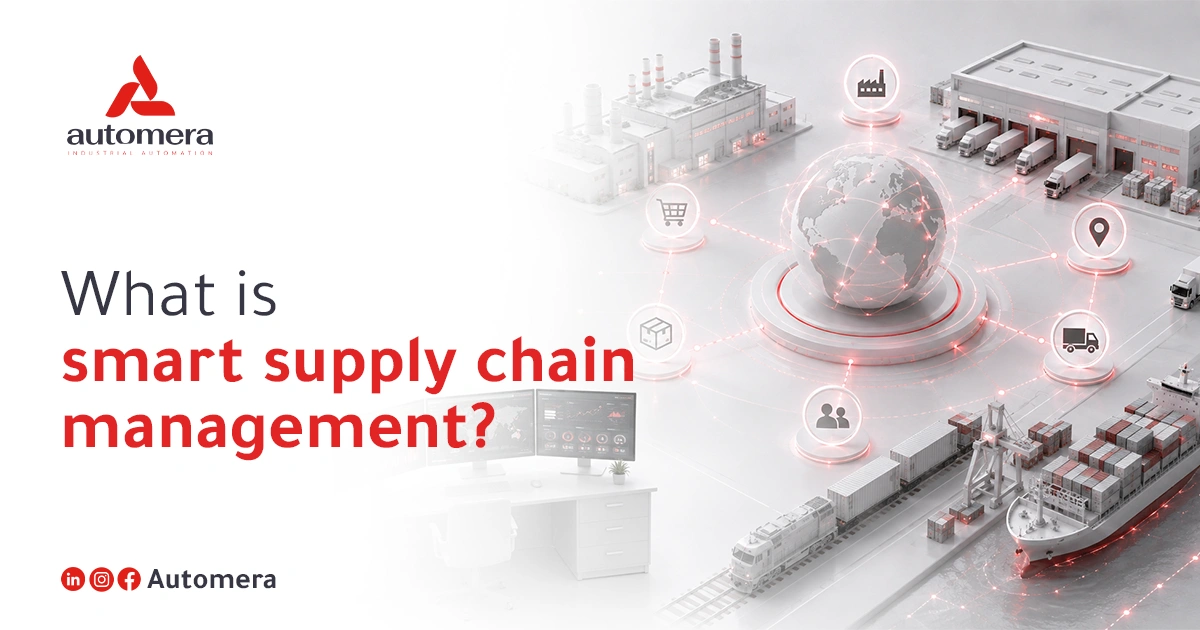
Smart supply chain management helps companies respond more effectively to complex markets and rapidly changing demand by connecting data, operations, and digital technologies within a clearer and more responsive system.
It improves planning, tracks the movement of materials and resources, supports faster data-based decisions, reduces errors, and raises operational efficiency. In this guide, Automera explains smart supply chain management and how it can support the growth of your factory.
What is Smart supply chain management?
supply chain what is? Smart Supply Chain Management is an integrated system that combines data, digital technologies, and automation across the different stages of the supply chain. It manages the flow of materials, information, and resources in a connected way, from the supplier to the delivery of the product or service to the customer.
The supply chain covers planning, procurement, production, inventory management, warehousing, transportation, and distribution. These stages are connected through systems and technologies that allow data to move between them more efficiently.
How did Supply Chains Evolve from Traditional to Smart management?
This transition did not happen at once. Supply chain management evolved as markets expanded and technologies emerged that could connect operations and analyze larger volumes of data. The main stages of this development include:
- Reliance on manual processes: Traditional supply chains depended heavily on manual records and communication. Planning, inventory, transportation, and procurement operated separately, making it difficult to obtain a complete view of operations.
- The introduction of integrated digital systems: Companies began using planning and management systems to collect data and connect parts of the supply chain instead of keeping information scattered across separate departments.
- The shift to real-time data: Advances in connectivity and sensor technology made it possible to track inventory, materials, and orders faster, without waiting for periodic reports to reveal problems after they occurred.
- The use of advanced analytics: Companies began using analytics to forecast demand, improve planning, and identify problems that could disrupt operations.
- The growing role of automation and connected systems: Technologies such as the Internet of Things, robotics, and automation enabled companies to perform certain tasks automatically, monitor operations, and connect warehouses, production, and transportation more closely.
- The development of smarter supply chain management: Today, smart supply chains combine data, technology, and connected processes to help companies make faster decisions and respond more effectively to changes in demand and operating conditions.
How does Smart Supply Chain Management Work?
Smart supply chain management relies on the flow of data across the different stages of the supply chain. This data is then used to monitor operations, analyze performance, and make faster, more accurate decisions. The process usually follows a series of connected steps:
- Data is collected from suppliers, inventory, warehouses, production, transportation, and customer orders using digital systems, sensors, and tracking technologies.
- Data from different departments is connected within a smart scm system or platform to provide a clearer view of materials, products, and orders.
- Operations are monitored continuously to detect changes in inventory levels, delivery schedules, and shipment movements without relying solely on periodic reports.
- Data is analyzed to identify patterns, forecast demand, and anticipate potential problems, helping teams make more accurate decisions at the right time.
- Repetitive processes are automated, including inventory updates, alerts, and replenishment orders triggered when stock reaches a defined level.
- Information is shared among suppliers, warehouses, production teams, and transportation providers so that all parties work with consistent and current data.
- Decisions and processes are improved continuously using actual results and new data collected across the supply chain.
What are the Core Components of Smart Supply Chain Management?
A smart supply chain management systems in manufacturing consists of:
- Integrated data that connects procurement, production, inventory, and transportation information within one environment.
- Real-time visibility for continuously tracking materials, products, and orders across the supply chain.
- Advanced analytics that turn data into insights for demand forecasting, problem detection, and better decision-making.
- Automation that handles recurring processes, alerts, and actions more efficiently while reducing manual work.
- Integration among systems such as ERP, MES, WMS, and tracking tools to support data exchange across operations.
- Intelligent inventory and demand planning that balances expected requirements with stock levels and available resources.
- Connected supply chain participants, including suppliers, production teams, warehouses, and distribution providers, within an integrated information network.
What are the main Technologies used in Smart Supply Chain Management?
Smart supply chain management uses a range of technologies to connect operations, collect and analyze data, and automate selected decisions. These technologies include:
Artificial intelligence in supply chains
Artificial intelligence and machine learning analyze historical and real-time data, forecast demand, optimize inventory levels, and identify patterns that help companies make more accurate decisions.
Advanced data analytics
Advanced analytics tools turn large volumes of data into useful information for forecasting requirements, optimizing inventory, and monitoring performance.
Cloud computing
cloud computing in supply chain management provides a digital infrastructure that gives different systems and locations access to data and computing resources. This makes information sharing and integration across supply chain participants easier.
Digital twins
A digital twin creates a virtual model of a physical asset or process. Companies can use it to understand performance, test different scenarios, and support planning without making direct changes to actual operations.
Robotics and autonomous systems
Robots and autonomous systems support warehouse operations, material handling, and internal transportation. Examples include automated guided vehicles and autonomous mobile robots, which accelerate operations and reduce reliance on repetitive manual tasks.
Internet of Things
Connected devices and sensors collect data directly from equipment, inventory, and product movements. This supports real-time monitoring, improves planning, and allows teams to respond to changes faster.
RFID and sensor technologies
RFID tags and sensors identify the locations of materials and products, track their movement, and collect related data. This improves real-time visibility across warehouses and operational stages.
Cybersecurity
Cybersecurity becomes essential as systems grow more connected and exchange larger volumes of data. It protects the digital infrastructure, data, and communications used across the supply chain.
What role does Industry 4.0 play in Developing Smart Supply Chain Management?
Industry 4.0 has advanced smart supply chain management often referred to as supply chain management 4.0, by bringing together digital systems, data, connectivity, and automation. This has allowed companies to build more connected operations that respond more effectively to change.
- It connects procurement, production, inventory, and logistics through data exchange instead of allowing each function to operate separately.
- It improves visibility across the supply chain through data from connected systems and devices, giving companies a clearer view of operations and resource movement.
- It improves planning and forecasting by analyzing larger volumes of data and using the results to manage demand changes and improve procurement and inventory decisions.
- It increases automation in supply chain management across operational processes, reducing reliance on manual tasks and improving execution efficiency.
- It supports faster responses to changes and disruptions by making information available sooner and enabling decisions based on current data.
- It turns supply chains into more connected networks in which participants and systems exchange information continuously, creating more flexible and integrated supply chains.
What are the Benefits of Smart Supply Chain Management for Companies?
Smart supply chain management gives companies a clearer view of their operations and helps them use data to improve planning, make better decisions, and respond to change faster. Its main benefits include:
Clearer operational visibility
When data from procurement, inventory, production, and transportation flows into connected systems, companies can see what is happening across the supply chain at the right time.
Better inventory management
Accurate data and improved demand forecasting provide a more realistic basis for determining required quantities and replenishment schedules. This helps reduce stockouts and prevents companies from holding unnecessary excess inventory.
Faster, data-based decisions
Digital systems provide access to current data instead of relying on scattered information or delayed reports. Companies can turn this data into useful information for planning, setting priorities, and responding to changes.
Fewer errors and higher operational efficiency
Automation and system integration reduce repetitive manual work and lower the risk of information being lost or recorded differently across departments.
Greater ability to manage disruptions
A smart supply chain helps companies respond more effectively to changing demand, supplier delays, and transportation problems.
A better customer experience
Clear information about order status, inventory availability, and delivery schedules allows companies to provide customers with more accurate updates and reduce delays and order fulfillment errors.
Stronger collaboration across departments and partners
The value extends beyond technology. Connected data makes it easier for planning, procurement, inventory, and production teams to work together.
Which Industries Benefit from Smart Supply Chain Management?
Many sectors and industries benefit from smart supply chain management, including:
- Manufacturing, where it improves production planning, coordinates materials and inventory, and helps factories respond to changes in demand.
- E-commerce and retail, where it supports inventory management, order fulfillment, multiple sales channels, and fast-changing customer expectations.
- healthcare supply chain and pharmaceutical supply chain process, where it tracks supplies and medicines, improves inventory accuracy, and supports cold chains and on-time delivery.
- Transportation and logistics, where it supports demand forecasting, route optimization, and more efficient shipment and operations tracking.
- Automotive manufacturing, where operations depend on coordinating suppliers, components, production, and distribution across connected networks.
- Consumer goods and food production, where it improves product availability, demand and inventory management, and traceability across supply and distribution stages.
- Energy and engineering industries, where automation, data, and connected systems improve the flow of materials, assets, and operations.
How does Smart Supply Chain Management Support E-commerce?
Smart supply chain management helps e-commerce businesses in several areas:
Real-time inventory visibility
Real-time inventory data shows the quantities available for sale across the online store and other channels. This reduces the risk of selling unavailable products or losing orders because of inaccurate stock information.
Faster order fulfillment
When order data is connected with inventory, warehouse, and shipping systems, each order can be directed quickly to the most suitable fulfillment location based on product availability. This shortens processing time and reduces delays before shipment.
Responding to changes in demand
E-commerce demand can change quickly, with sudden increases in sales. Current data and full visibility into inventory and orders help companies adjust their plans and respond faster.
Connecting different sales channels
When a company sells through an online store, digital marketplaces, and physical branches, system integration creates a single view of products, inventory, and orders instead of managing each channel separately.
Improving the customer experience
Accurate inventory information and order and shipment tracking help stores provide realistic delivery dates and keep customers informed about their orders. They also reduce problems caused by stockouts and unexpected fulfillment delays.
More efficient returns management
The supply chain does not end when an order is delivered. E-commerce businesses need to process returns, update product status, and return suitable items to available inventory.
What are the main Challenges of Implementing Smart Supply Chain Management?
Manufacturers can face several challenges when implementing smart supply chain management:
- Integrating legacy systems with new digital solutions can be complex, especially when data is stored across separate platforms.
- Poor or fragmented data reduces the accuracy of the analytics and decisions used in smart supply chain management.
- High implementation costs and difficulty proving return on investment can delay digital transformation projects.
- Limited digital skills can make it harder to operate modern systems and use their capabilities effectively.
- Cybersecurity and data protection become more important as systems grow more connected and supply chain participants exchange more information.
- Scaling a successful pilot across wider operations can be difficult when the technical infrastructure was not designed for expansion from the beginning.
How can Companies Move from Traditional to Smart Supply Chains?
The following steps can help a company move from traditional supply chain management process to a smarter model:
- Assess the current situation by reviewing existing processes, systems, data, and skills, then identify weaknesses that slow operations or limit information visibility.
- Set clear transformation goals linked to business needs, such as improving inventory accuracy, shortening order fulfillment time, or increasing operational visibility, instead of adopting technology simply to keep up with change.
- Create an implementation roadmap that defines priorities, required technologies, and the order of projects while considering current capabilities and the results expected at each stage.
- Prepare the data and connect systems. Smart supply chain management requires accessible data that can move across different operations, rather than isolated systems within each department.
- Begin with a defined pilot project to test the solution in a real operating environment and measure its value before wider implementation. This reduces the risk of investing in solutions that fail to deliver the required results.
- Develop employee skills alongside the introduction of new technologies so teams can use digital tools and data in their daily decisions.
- Expand gradually after proving the results by applying successful solutions to other operations or locations and adapting them to the needs of each part of the supply chain.
- Measure performance and improve continuously. Transformation continues after new systems are launched and requires regular reviews as the needs of the company and market change.
What are the Best Smart Supply Chain Management Solutions in 2026?
No single solution is suitable for every company. Smart supply chain management solutions in 2026 are increasingly focused on artificial intelligence, real-time visibility, integrated planning, and connecting execution with operational data. The main solutions include:
AI-powered planning platforms
Supply chain planning systems bring demand, supply, inventory, and operational capacity planning together. They use artificial intelligence to detect changes, analyze scenarios, and recommend actions when shortages or planning imbalances appear.
Supply chain control towers
Supply Chain Control Towers give companies a unified view of data from suppliers, factories, inventory, and transportation. They monitor events and alerts, analyze the effect of disruptions, simulate scenarios, and identify issues that require a rapid response.
Smart warehouse management systems
Modern Warehouse Management Systems go beyond recording inventory movements. They use artificial intelligence and machine learning to estimate order-processing times, support intelligent inventory counting, and analyze product movement patterns inside the warehouse.
Transportation management systems
TMS solutions help plan, execute, and track shipments, select suitable routes and carriers, and manage SCM logistics operations from a single source.
Supply chain digital twins
A supply chain digital twin creates a virtual model of operations using real data. Companies can monitor performance and test the effect of changes or disruptions before making decisions in actual operations.
Tracking and real-time visibility solutions
These systems collect inventory, order, and shipment data from different sources. They display current status and product movement across the supply chain, making delays and deviations easier to detect and allowing companies to track each journey from origin to destination.
Integrated supply chain management platforms
Integrated supply chain management platforms bring procurement, inventory, planning, logistics, execution, and the supplier management system into one unified environment.
Why do factories in Saudi Arabia need integrated smart supply chain solutions?
Factories and supply chain management companies in Saudi Arabia need integrated smart supply chain solutions for several reasons:
- Keeping pace with logistics sector growth: As Saudi Arabia continues to develop its transportation and logistics networks under Vision 2030, companies need systems that can manage larger and more connected operations.
- Reducing delays and costs: Clearer information about the movement of goods and their expected arrival times helps companies reduce waste, organize operations, and avoid some of the costs caused by delays.
- Improving tracking accuracy: Clear visibility into shipments and inventory makes it easier to detect delays or shortages and address them before they affect other operations.
- Connecting different transportation modes: Top supply chain companies in Saudi Arabia need better coordination across sea, air, road, and rail transport as logistics activity expands and goods move through different routes.
- Supporting e-commerce growth: Rising order volumes across digital channels require faster and more organized inventory, fulfillment, and shipping operations.
- Providing a clearer view of operations: Integrated solutions bring inventory, shipping, and procurement data together instead of leaving it scattered across separate systems. This gives management a clearer understanding of current operations and supports timely decisions.
- Supporting expansion without losing operational control: When a company adds warehouses, suppliers, or distribution channels, it needs a system that connects these elements and maintains clear data and order flows as the business grows.
How does Automera help companies build a smarter, more integrated supply chain?
Automera develops more connected scm supply chain management by bringing systems, data, and operations into one environment. Its solutions help manufacturers in the following areas:
Setting transformation priorities before investing
A SIRI assessment allows an organization to measure its readiness for Industry 4.0 and identify which areas should be developed first. This helps direct the budget toward actual operational needs instead of technologies that do not directly support the business.
Gaining better control over inventory and warehouses
Smart WMS records receiving, storage, issuing, and shipping movements in real time using barcodes or RFID. This gives management a more accurate view of inventory and reduces errors caused by manual recording or delayed data updates.
Connecting procurement with actual requirements
Automera digitizes the procurement cycle from purchase request to invoice and connects procurement with inventory and financial operations. This accelerates approvals, reduces errors, and provides a clearer record of what was ordered and what was actually received.
Connecting production with the supply chain
Industry 4.0 solutions and Manufacturing Execution Systems connect production and operating data with inventory and other processes. Management can track material requirements and production status without relying on separate information held by different departments.
Improving product and material traceability
Automera provides digital serialization and traceability solutions that help organizations track product movement and document related data throughout operational stages. These solutions are especially useful in regulated industries and operations that require detailed traceability.
Building one connected system instead of separate solutions
The greatest value comes from connecting warehouses, procurement, inventory, production, and traceability within a system that continuously exchanges data, rather than operating each solution separately.
What is the future of smart supply chain management?
The future of smart supply and chain management is moving toward systems with stronger forecasting, coordination, and data-based action capabilities. People will remain responsible for defining goals, setting controls, and making decisions that require experience and judgment. Future developments will include:
- A greater role for agentic AI: Systems will move beyond data analysis toward AI agents that can monitor events, assess alternatives, and carry out selected actions within controls defined by the company.
- Stronger connections across operations: Planning, procurement, manufacturing, and logistics will share a common data environment, reducing the gaps created when departments operate separately.
- More automation in warehouses and logistics: Companies will expand their use of robots and flexible systems that can connect and scale, especially for repetitive work, material movement, and order fulfillment.
- Greater emphasis on cybersecurity: Cybersecurity will become more important as connectivity increases among suppliers, systems, and digital platforms.
Contact Automera smart supply chain inc to explore solutions suited to your operations and develop a more efficient and intelligent supply chain for your factory.