Choosing the wrong manufacturing execution system can have a serious impact on a company’s operational performance. In manufacturing, even a small error can disrupt an entire production process. With the right Manufacturing Execution System (MES), manufacturers gain access to critical insights that help improve efficiency, reduce waste, and increase production output. In this article, Automera Smart Industrial Solutions explores how MES works and the benefits it offers across different industries.
What Is a Mes Manufacturing Execution System?
A Manufacturing Execution System, or MES, is a computer-based system that collects real-time production data from all or part of a factory. This data gives manufacturers greater control over production through process monitoring, traceability management, quality control, preventive maintenance management, and other functions.
mes industrial automation sits between two main layers of the industrial technology environment:
- Enterprise Resource Planning (ERP) at the upper level: ERP determines what the company should produce, in what quantity, and when. It also manages purchasing, accounting, and overall business planning.
- Automation and control systems at the lower level: These include PLCs, SCADA systems, and the machines themselves, which directly control and operate equipment on the factory floor.
What Does a Manufacturing Execution System (MES) Do?
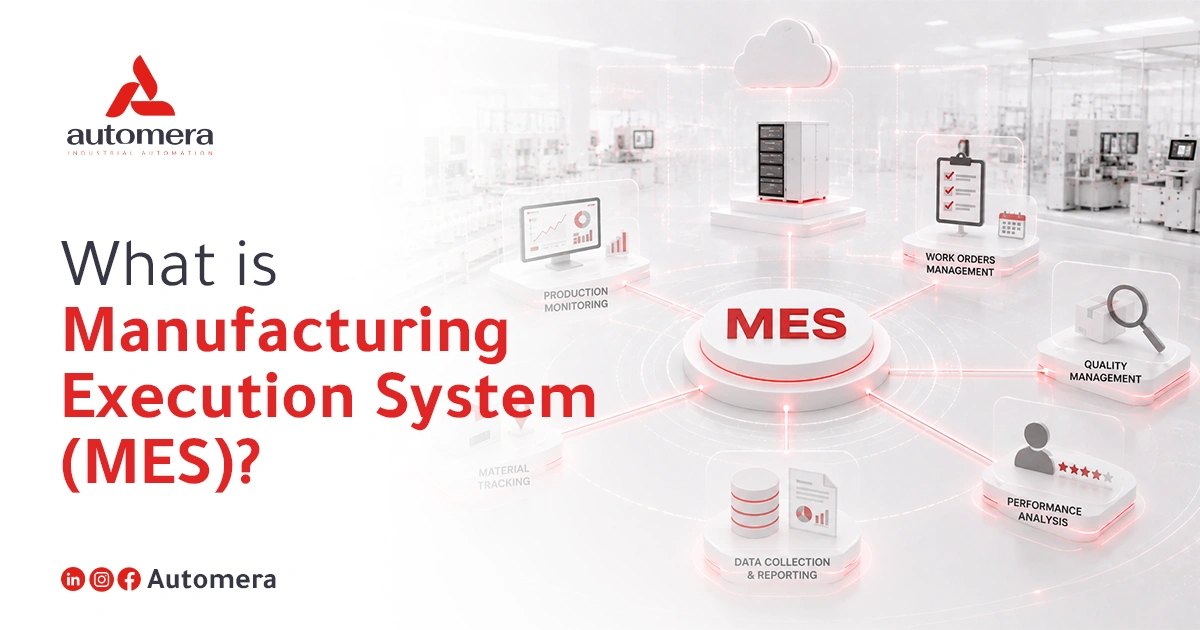
An MES converts the production plan into clear instructions that can be carried out on the factory floor. It also records what happens at each stage of the manufacturing process. Most MES solutions cover the following functions:
- Production scheduling and task allocation: The system assigns work orders to production lines, equipment, and workers based on real-time capacity.
- Production tracking: It tracks every production order and manufactured unit, from the arrival of raw materials to the completion of the finished product.
- Quality management: It records inspection results, verifies that each stage meets quality requirements, and alerts the responsible teams when a deviation occurs.
- End-to-end traceability: It maintains records of the raw material batches, components, and operating settings used to manufacture each product.
- Performance and OEE measurement: It measures equipment availability, performance, and production quality, helping manufacturers identify sources of downtime and hidden losses.
- Maintenance management: It organizes preventive maintenance activities and records the causes of equipment failures and unplanned downtime.
- Data collection: It automatically collects data from machines and sensors through technologies such as IIoT, PLCs, and the OPC UA protocol, reducing reliance on manual data entry and paper records.
- Workforce management: It records workers’ skills and certifications and helps assign tasks to the right people on the factory floor.
How Does DELMIA MES Work?
DELMIA MES begins working before a production order reaches the factory floor. When a product design is modified or a new version is released, the updated data is transferred to production teams through the 3DEXPERIENCE platform. The factory then records execution results and any issues that arise during production, allowing this information to flow back to the design and planning teams.
Inside the factory, DELMIA Apriso is often included in a list of MES software designed for large manufacturers operating across multiple production sites. Teams can see the current stage of each order and identify downtime or delays as they occur.
The system also integrates with ERP solutions such as SAP and Oracle, as well as Product Lifecycle Management (PLM) systems. Organizations operating multiple factories can use this integration to standardize workflows and monitor production from a single system.
What Are the Benefits of Using the Best Manufacturing Execution Systems (MES)?
digital manufacturing mes shows what is happening inside your factory in real time and gives managers an accurate view of operations without waiting for data to be collected at the end of a shift. Its main benefits include:
- Clear production visibility: Up-to-date information about work orders, equipment status, and the current stage of production without waiting for end-of-day reports.
- Fewer errors and less waste: Early detection of deviations prevents errors from continuing and affecting larger quantities of products.
- Better and more consistent quality: Recording inspection results at each stage helps control quality and reduce recurring defects.
- More accurate product traceability: A complete record links each unit to the raw materials, machine settings, and workers involved in its production.
- Easier regulatory compliance: Electronic production records simplify audits, especially when using MES in the pharmaceutical industry. Get your pharma mes system from automera.
- Higher equipment efficiency: Identifying the causes of downtime, bottlenecks, and long changeover times helps improve OEE and production output.
- Faster and more accurate decisions: Live production data gives managers a clear basis for addressing problems and choosing the appropriate action.
- Lower quality-related costs: Detecting defects during production reduces the cost of rework or product recalls after shipment.
What Are the Challenges of Using a Mes system ?
Most mes factory automation challenges are not caused by the system itself but by how it is planned and implemented inside the factory. Starting with a clear scope and selecting the functions that production actually needs makes the project easier to implement and manage. Common challenges include:
- Different systems and machines: Older equipment and software from different vendors can make integration more complex. The factory’s technical infrastructure should therefore be assessed before selecting a system.
- Expanding project scope: Connecting production, quality, maintenance, and inventory in a single phase may delay implementation. Dividing the project into stages makes it easier to monitor results.
- Initial cost: Costs increase with the number of production lines, sites, and required equipment. They can be controlled by setting priorities and starting with the processes that have the greatest impact.
- Employee acceptance: Some workers may resist changing familiar methods. Early involvement and practical training help them understand how the system will support their daily work.
- Data readiness: MES results depend on the accuracy of data received from machines. Some equipment may therefore require additional sensors or communication gateways.
- Implementation time: Large projects require more time for preparation and testing, while a limited implementation is faster and easier to evaluate.
- Updates in regulated industries: Some system updates may require revalidation before they can be used in production, especially in pharmaceutical factories.
These challenges do not prevent a factory from benefiting from a Manufacturing Execution System. They simply show the importance of choosing an implementation plan that matches the factory’s size and capabilities. A factory can begin with a small project, measure its impact, and expand the system based on actual results.
Industries That Use Manufacturing Execution Systems
If your factory needs real-time production monitoring, material and component traceability, or documented quality results, an MES can support these requirements. The system is used across many industries, with each factory applying it according to the nature of its operations. The most common industries include:
- Pharmaceuticals and life sciences: These factories need a clear record of every batch and each stage of production. Applications mes in pharma industry support traceability, GMP requirements, and electronic records.
- Automotive: Assembly lines benefit from knowing which components were used in each vehicle, especially when a defect is discovered or a specific group of vehicles must be recalled.
- Food and beverage: The system tracks ingredients, production batches, and food safety procedures, making it easier to identify the source of a problem.
- Aerospace and defense: MES supports complex, high-value products in which every part requires a record of its manufacturing stages and completed operations.
- Electronics and semiconductors: The system detects small changes in production and quality before they lead to high levels of waste.
- Medical devices: It combines traceability and quality control while retaining the data required for reviews and audits.
- Chemicals and continuous manufacturing: MES tracks recipes, batches, and operating data while helping factory teams control processes and monitor compliance with safety procedures.
What Is the Difference Between MES and ERP?
This is one of the most common sources of confusion, so it is important to explain the distinction clearly:
Enterprise Resource Planning (ERP)
- Focuses on managing business operations, including finance, procurement, sales, and human resources.
- Supports planning across days, weeks, or months.
- Provides general data on order quantities, inventory, and costs.
- Used by management, finance, planning, and procurement teams.
- Operates at Level 4 of ISA-95, which covers business planning.
Manufacturing Execution System (MES)
- Focuses on production execution, quality control, and equipment monitoring on the factory floor.
- Processes operational data in real time.
- Provides detailed data on machines, individual units, and sensor readings.
- Used by factory managers, supervisors, operators, and quality engineers.
- Operates at Level 3 of ISA-95, which covers manufacturing operations.
How Do MES and ERP Work Together?
Production data moves between MES and ERP in a clear cycle:
- ERP defines what needs to be produced: It prepares work orders, required quantities, bills of materials, and production schedules.
- MES tracks what actually happens: It assigns tasks and records production output, material consumption, quality results, and the causes of downtime.
- The results return to ERP: Inventory, costs, and order status are updated using the actual figures recorded on the factory floor.
This allows factory owners to compare planned quantities with actual production while keeping management data aligned with what is happening on production lines.
How Can MES and ERP Be Implemented Successfully?
Connecting MES and ERP requires a clear plan that reflects the factory’s operations and existing systems. The project can be implemented through the following steps:
- Choose a clear starting point: Begin with one production line or a specific problem, such as recurring downtime or high waste levels.
- Define each system’s responsibilities: ISA-95 clarifies what ERP manages, what MES handles, and where automation systems fit within the project.
- Use employees’ practical experience: Involving supervisors and operators early helps ensure that the new workflow reflects actual factory operations.
- Plan the integration from the beginning: Define which data will move between ERP, MES, and SCADA, as well as how it will be transferred, before configuring the system.
- Implement the project in stages: Test the first phase and apply the lessons learned before expanding to other production lines or sites, especially in regulated industries.
- Establish baseline figures: Recording OEE, waste rates, and downtime before implementation makes it possible to measure the improvement achieved afterward.
- Prepare a training plan: Teams need time to learn and test the system, with designated people inside the factory who can provide support when problems arise.
- Select the deployment model: The choice between a cloud-based system and an on-premises system depends on the required implementation speed, the IT team’s capabilities, and compliance requirements.
Implement MES with Automera and gain faster integration, more accurate data, and clearer visibility into your factory operations.
What Is the Difference Between MES and SAP?
SAP can manage production planning, materials, and costs, but it may not always provide the level of detail that operations teams need when working with machines and individual workstations. This is where a specialized MES plays an important role.
- SAP defines what needs to be produced: It specifies production orders, quantities, materials, and schedules.
- MES tracks how production is executed: It records operating steps, equipment status, actual output, and quality results.
- SAP manages enterprise data: It connects production with inventory, procurement, and financial information.
- MES collects factory-floor data: It connects to machines and sensors and shows what is happening during production.
- SAP relies on standardized processes: MES can be configured to support the production routes, repair loops, and operating requirements of each factory.
- MES provides deeper traceability: This makes it especially important for factories operating under strict regulatory requirements.
The two systems can be connected so that each performs its appropriate role, rather than relying on SAP alone to manage every detail of production.
How Much Does the Mes Execution System Cost?
The cost of a factory mes system depends on what your factory actually needs. One factory may begin with a single production line, while another may need to connect multiple sites and systems. The main factors affecting cost include:
- Implementation scope: Applying the system to one production line differs from implementing it across the entire factory.
- Equipment condition: Modern machines may connect directly to the system, while older equipment may require additional sensors or communication gateways.
- Existing systems: The required integration with ERP, SCADA, quality, and inventory systems affects the overall implementation cost.
- Required functions: The cost varies depending on whether the factory needs production tracking, quality management, maintenance management, or all these functions.
- Deployment model: Cloud-based and on-premises systems have different requirements for subscriptions, servers, and maintenance.
- Additional services: Training, support, updates, and customization are included when calculating the total cost.
Top mes software companies Automera determines the cost after assessing the factory’s requirements, allowing factory owners to pay for the functions and integrations they actually need.Get best mes software Now.
mes system examples
Automera is an example of mes software solutions that combines production monitoring with AI-powered analysis. The system records what happens on the factory floor and analyzes operating data to detect unusual changes.
Automera does more than display a problem after it has occurred. When the system detects a risk that may affect production, it alerts the responsible team so they can intervene before waste increases or downtime continues. Factory data therefore becomes a practical tool for addressing problems early.
What Is the Future of Manufacturing Execution Systems?
The future of MES is moving beyond recording what has already happened toward predicting what may happen next. Artificial intelligence is leading this change by analyzing production data during operation.
- Predictive analytics: Detecting signs of downtime or waste before they affect production.
- More accurate alerts: Sending warnings to the responsible team with information that helps them understand and address the problem.
- Scalable systems: Starting with one production line and adding new functions or sites according to the factory’s needs.
- Cloud and edge connectivity: Combining cloud access with local data processing to maintain operational continuity.
- Production simulation: Testing changes digitally before applying them to production lines and equipment.
- Intelligent workforce support: Providing direct instructions and information to help factory teams perform their tasks.
Factories that are best prepared for the future are those that begin improving their operations today. Contact Automera to implement top mes systems and connect it to your existing factory systems. Move beyond identifying problems after they occur and start detecting and addressing them earlier.