What is a MES?
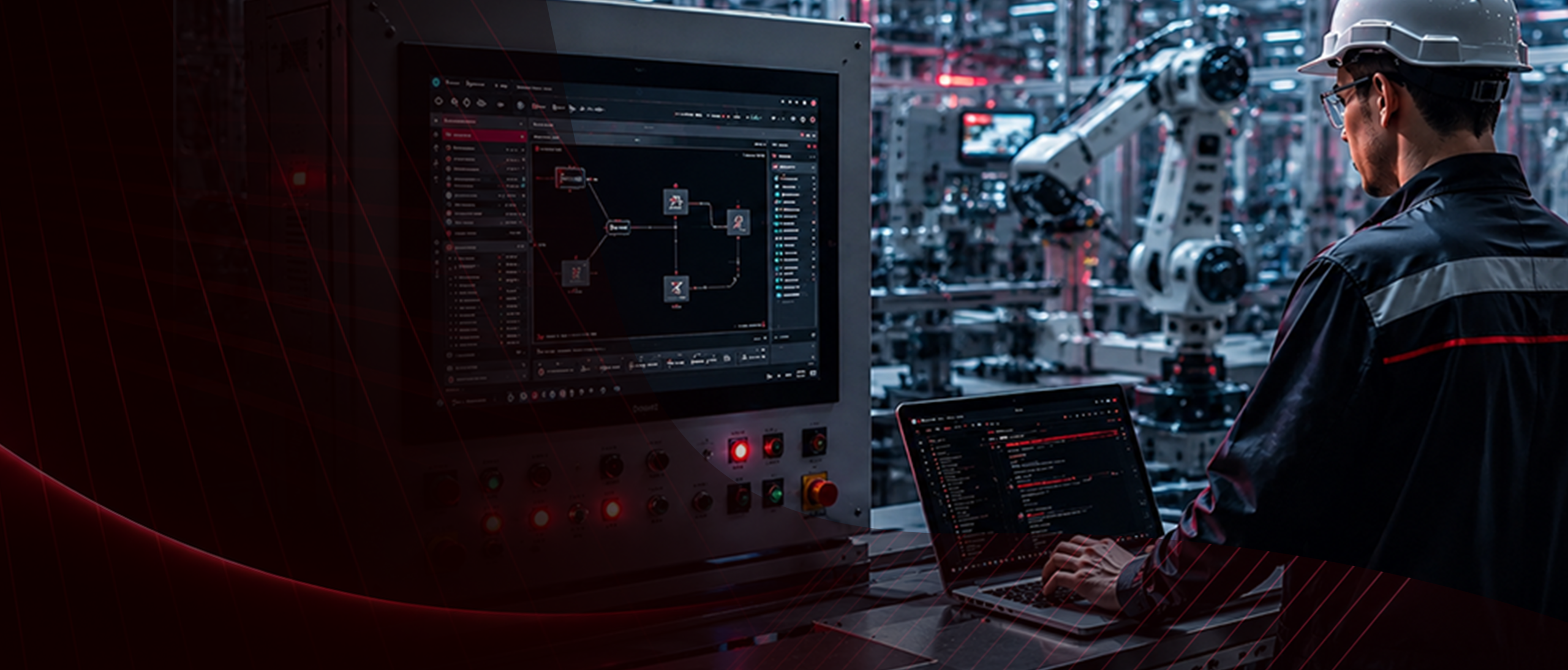
A Manufacturing Execution System (MES) is the bridge between ERP production planning and what actually happens on the factory floor. It monitors, controls, and documents every manufacturing step from raw materials to finished products while providing real-time operational visibility.
Why Does Your Factory Need MES?
Many factories struggle with operational inefficiencies caused by disconnected systems and delayed information.
Lack of Real-Time Visibility
Limited insight into production performance and machine conditions.
Paper Based Processes
Delayed reporting leads to slower decisions and higher error rates.
Difficult Product Traceability
Challenges identifying affected batches or root causes during incidents.
Regulatory Compliance Challenges
Especially critical for pharmaceutical and food manufacturing industries.
Increased Downtime & Waste
Without real-time analytics, operational inefficiencies become harder to detect.
Core MES Functions
The Manufacturing Execution System supports end-to-end production management through 6 core operational functions
Production Tracking & Work Orders
Monitor production lines and track work orders from start to completion in real time.
Scheduling & Resource Optimization
Optimize production planning, machine utilization, and resource allocation.
Integrated Quality Management
Quality control checks throughout every production stage — not only at final inspection.
OEE Monitoring & Performance Analytics
Measure machine efficiency, analyze downtime and waste, and generate actionable reports.
Traceability & Material Management
Track raw material consumption with complete forward and backward traceability.
Maintenance & Workforce Management
Integrate preventive maintenance and workforce productivity with live production data.
What Return Does MES Deliver to Manufacturers?
MES transforms shop-floor data into clear performance indicators, helping you make fast, accurate decisions instead of relying on guesswork or delayed reports to improve production, quality, and decision-making speed.
Manufacturing Execution System (MES)
Optimize Production Performance
-
MES provides real-time visibility into production lines and machine performance, helping manufacturers identify losses, downtime, and productivity gaps.
-
By tracking downtime and linking it to machines, lines, products, shifts, and root causes, MES helps teams analyze recurring issues and reduce their impact on production.
-
MES connects production steps with inspection and quality points, enabling early error detection and reducing rejected or reworked products.
-
MES replaces manual records and spreadsheets with accurate digital records for production, quality, batches, and operations.
Manufacturing Execution System (MES)
Enhance Operational Visibility & Control
-
MES helps identify where materials came from, when they were used, on which line, by which operator, with which inspection results, and in which finished product.
-
MES provides dashboards and real-time reports that allow management to understand factory status without waiting for end-of-shift or daily reports.
-
In industries that require accurate documentation, such as food, pharmaceutical, chemical, and packaging industries, MES supports digital records linked to production, quality, and traceability.
-
MES brings operational data into one connected system, reducing gaps between teams and helping the factory understand how each function affects performance.
Expected MES Impact
MES turns daily factory data into clear operational value.Instead of relying on assumptions or delayed reports, MES gives your factory real-time visibility to improve efficiency, reduce downtime, enhance quality, and trace every step of the manufacturing process.
Our MES Implementation Process
At Automera, we follow a structured and practical implementation methodology.
Current State Assessment
Evaluate existing systems, workflows, and operational gaps.
Solution Design
Build a customized MES solution tailored to your manufacturing environment.
Expertise in Industrial Digital Transformation
Deep expertise in implementing MES and Industry 4.0 solutions within Saudi factories, from OEE improvement and quality systems to full traceability and electronic records.
Training & Enablement
Train operational and management teams for effective system adoption.
Continuous Support & Optimization
Provide ongoing technical support and operational improvements.
Where Does MES Fit in the System Hierarchy?
MES acts as the connection layer between enterprise management systems and machine-level control systems.
ERP (Planning & Management)
MES (Execution & Real-Time Monitoring)
SCADA / PLC (Machine Control & Automation)
Hierarchy Overview
This structure creates a fully connected smart manufacturing environment.
ERP
handles planning, inventory, finance, and resources.
MES
manages production execution and operational monitoring.
SCADA / PLC
control machines and industrial equipment directly.
Industries We Serve
Pharmaceutical Manufacturing
Compliance-focused MES solutions with traceability and electronic records.
Food & Beverage Manufacturing
Improve production quality, consistency, and operational efficiency.
FMCG Manufacturing
Support high-volume manufacturing environments with real-time visibility.
Government & Industrial Manufacturing
Enable industrial digital transformation and operational modernization.
Chemical Manufacturing
Precise production monitoring and process control solutions.
Why Choose AUTOMERA?
Deep Industrial Understanding
We understand manufacturing operations — not just software implementation.
Scalable Smart Manufacturing Solutions
Our MES systems are designed to grow with your factory operations.
Seamless System Integration
We integrate with your existing infrastructure without costly replacements.
Strong Industry 4.0 Expertise
Our expertise includes: MES Saudi Arabia / Smart Manufacturing / Industry 4.0 Solutions / Digital Factory Transformation / OEE & Quality Systems / Traceability & Electronic Records
Frequently Asked Questions
-
What is the difference between MES and ERP?ERP focuses on planning and business management, while MES focuses on real-time production execution and factory operations.
-
Can MES integrate with our existing systems?Yes. MES can integrate with most ERP, PLC, SCADA, and industrial systems.
-
How long does implementation take?Implementation duration depends on factory size and operational complexity, but projects are typically executed in phased deployments.
-
Is MES suitable for medium-sized factories?Yes. MES solutions can be customized for small, medium, and large manufacturing facilities.
Start Your MES Journey Today
Ready to take full control of your production operations? Speak with an Automira expert and let's build your smart factory roadmap together